
Calls grow for expansion of state’s treatment courts
/
Legal advocates and elected officials rallied for a New York State Senate hearing calling for support for the Treatment Court Expansion Act. Eagle photo by Noah Powelson
By Noah Powelson
The leaders of New York’s courts, a number of elected officials, lawyers and advocates together on Friday called on the state to reform its court system in a way that they say will prevent the cycle of incarceration hundreds of mentally ill New Yorkers experience every year.
At both a rally and a State Senate hearing that followed Friday morning, support was drummed up for the Treatment Court Expansion Act, which seeks to reform criminal procedure law in order to divert mentally ill persons charged with a crime away from incarceration and into Treatment Court.
The bill, if eventually passed, would allow for those charged with a crime who have a mental illness or substance-use disorder be diverted to a treatment plan, allow courts to consider offering diversion to any individual regardless of their accused crime, and remove the requirement for defendants to enter a plea deal in order to receive treatment.
The legislation has long been a priority of the court system’s current leadership, Chief Judge Rowan Wilson and Chief Administrative Judge Joseph Zayas, both of whom testified at the Friday hearing.
The bill’s supporters say TCEA would create pathways to recovery for thousands of mentally ill New Yorkers, lower recidivism rates and save the state hundreds of thousands of dollars.
The bill, sponsored by Queens State Senator Jessica Ramos, will be considered by the legislature in the upcoming 2026 legislative session.
At a rally held before the Senate Standing Committee on Alcoholism and Substance Use Disorders’ hearing on the TCEA, Ramos said it was time to end the cycle of incarceration some with severe mental illnesses fall into.
“Our criminal legal system has the opportunity to improve the way that we serve justice on the streets of New York,” Ramos said. “It’s no longer the 1600s, it’s not about throwing someone in the dungeon, locking them up and throwing away the key. There are consequences to that.”
“This isn’t only about compassion, it isn’t even about doing the right thing, it’s about saving the state millions of dollars at a time when we can’t rely on the federal government,” Ramos added.
Wilson, who has long advocated for the expansion and further funding of problem-solving courts like Treatment Court, also testified at the Friday hearing. He shared the story of a woman who long struggled with drug addiction but who avoided incarceration for a narcotic sales charge because the judge overseeing her case diverted her to a substance abuse program. Wilson said the woman eventually graduated the program, had her charges dismissed, and started a family upstate.
Testifying before the committee, Wilson said that often those who commit crimes that harm others do not have a support system to bring them into recovery. The story of the woman, Wilson said, is an example of the positive impact the courts can have when recovery is prioritized over punishment.
“I don’t think there’s anybody who would say that they would rather have the community be less safe than more, but the system that we have now is doing just that,” Wilson said.
There would be some upfront costs associated with the passage of the bill, but Wilson claimed the bill would pay for itself over time as incarcerating people has proven to be far more costly than treating them. Studies indicate for every $1 the state spends in treatment courts, $2.21 is saved over the course of five years, the chief judge said.
Zayas, Wilson’s top deputy, has been a fan of treatment courts for years, dating back to his time running Queens’ Criminal Court.
Queens opened its own Treatment Court 20 years ago, and while Zayas said the recent funding and expansion of problem-solving courts in general have progressed greatly over the decades, much more needs to be done to meet the mental health needs of the state and court system.
“We have come so far in the years since I started mental health court,” Zayas said. “We now have over 350 problem solving courts in New York state, including 42 mental health courts, and we serve in 27 counties. A dozen more of these courts…are in the development stage.”
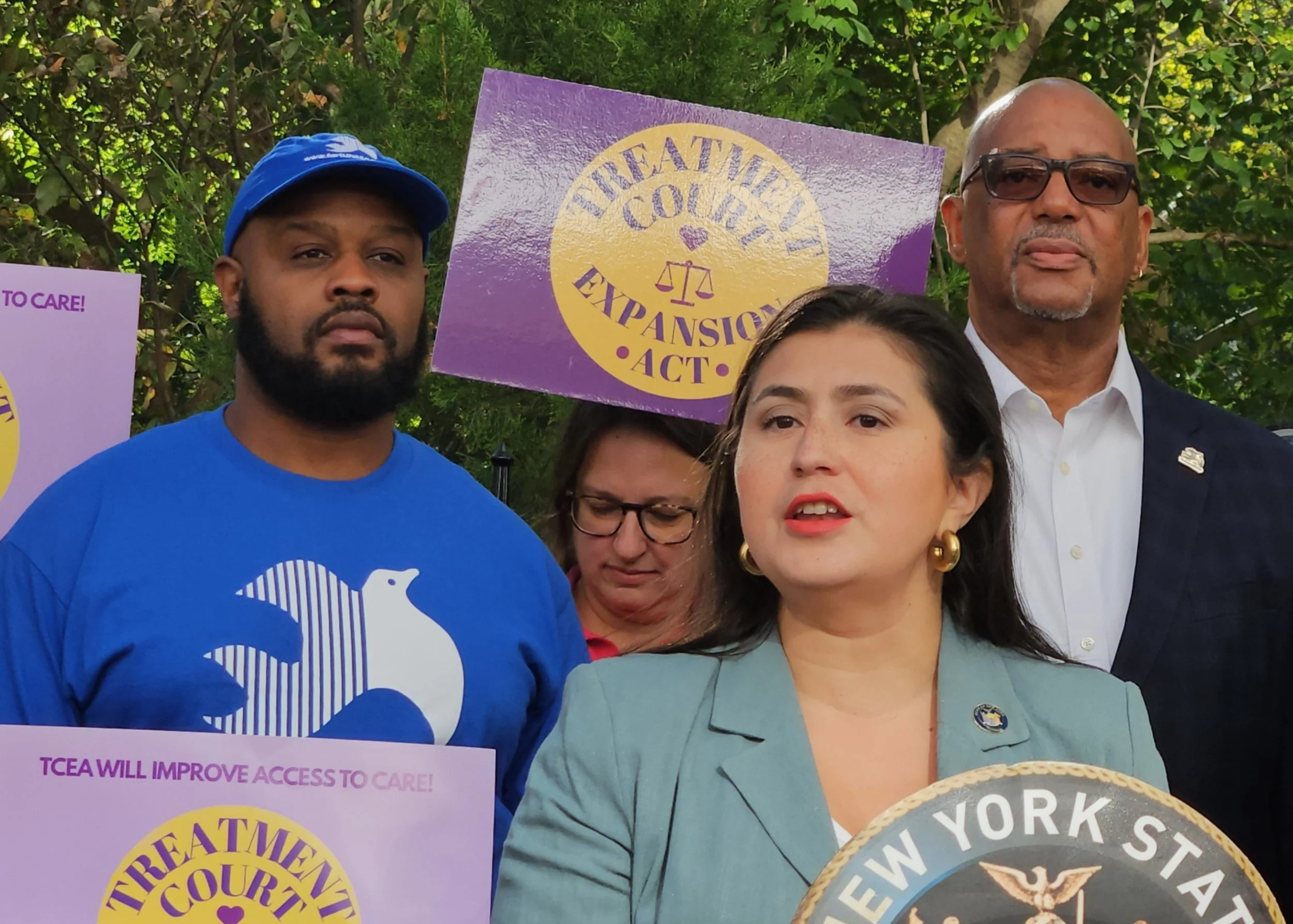
Queens State Senator Jessica Ramos sponsored a bill for the upcoming 2026 to create new methods for mentally ill persons charged with a crime to receive treatment in lieu of imprisonment.Eagle photo by Noah Powelson
TCEA has received endorsements from numerous public defender organizations, bar associations and other legal advocacy groups, including the Legal Aid Society and the New York City Bar Association.
Advocates of the closure of Rikers Island, where a dozen detainees have died this past year alone, have likewise called on the expansion of treatment courts as a feasible alternative option to keep mentally ill New Yorkers safe.
One such person was Justyna Rzewinski, a clinical social worker who worked on Rikers’ mental health units from December 2023 to December 2024. Rzewinski said during her time in Rikers, she saw mentally ill detainees locked in their cells without medication, therapy or human contact for weeks to months at a time. The result was that these already mentally fragile people deteriorated all the faster, becoming a greater risk to those around them and themselves.
“What I witnessed there was devastating,” Rzewinski said. “The truth is this, nobody is receiving meaningful mental health treatment at Rikers. People are being warehoused in cages, left to deteriorate, and then sent back into our communities more traumatized, more destabilized and in worse conditions than when they entered. Rikers is not a place of healing, it is a place of harm.”
At the hearing on Friday, another person who saw the inside of Rikers testified how treatment programs saved him from what he called, “hell on earth.”
Selwyn Bernardez was arrested in 2022 for striking a panhandler on a subway platform with a samurai sword after undergoing, what doctors at a psychiatric hospital called, a “grief-induced psychosis” when his mother fell into a terminal coma. Bernardez missed his mother’s funeral and spent the next six months on Rikers Island.
Bernardez described those six months as the worst experience of his life. He said every day was a fight for his life, where he was subject to uncaring officers, long delays for services, rotting food and a deteriorating mental health that wouldn’t be addressed for months before he finally received a therapist.
A judge eventually let Bernardez into an alternative to incarceration court after advocacy by his public defender.
After he was connected with treatment staff, received intensive therapy and established new connections with others going through the ATI court program, Bernardez eventually graduated from the program in 2024 and had his charges dismissed. He described his time in ATI as warm and compassionate, in stark contrast to his incarceration at Rikers.
“My path is not the norm, but it should be,” Bernardez said. “I am proof our mental health and substance use crisis are treatable, and Treatment Court program teaches us the skills we never had to manage our ongoing mental health struggles. Incarceration only teaches recidivism.”