Queens man gets new trial after appeals court finds judge favored prosecutors
/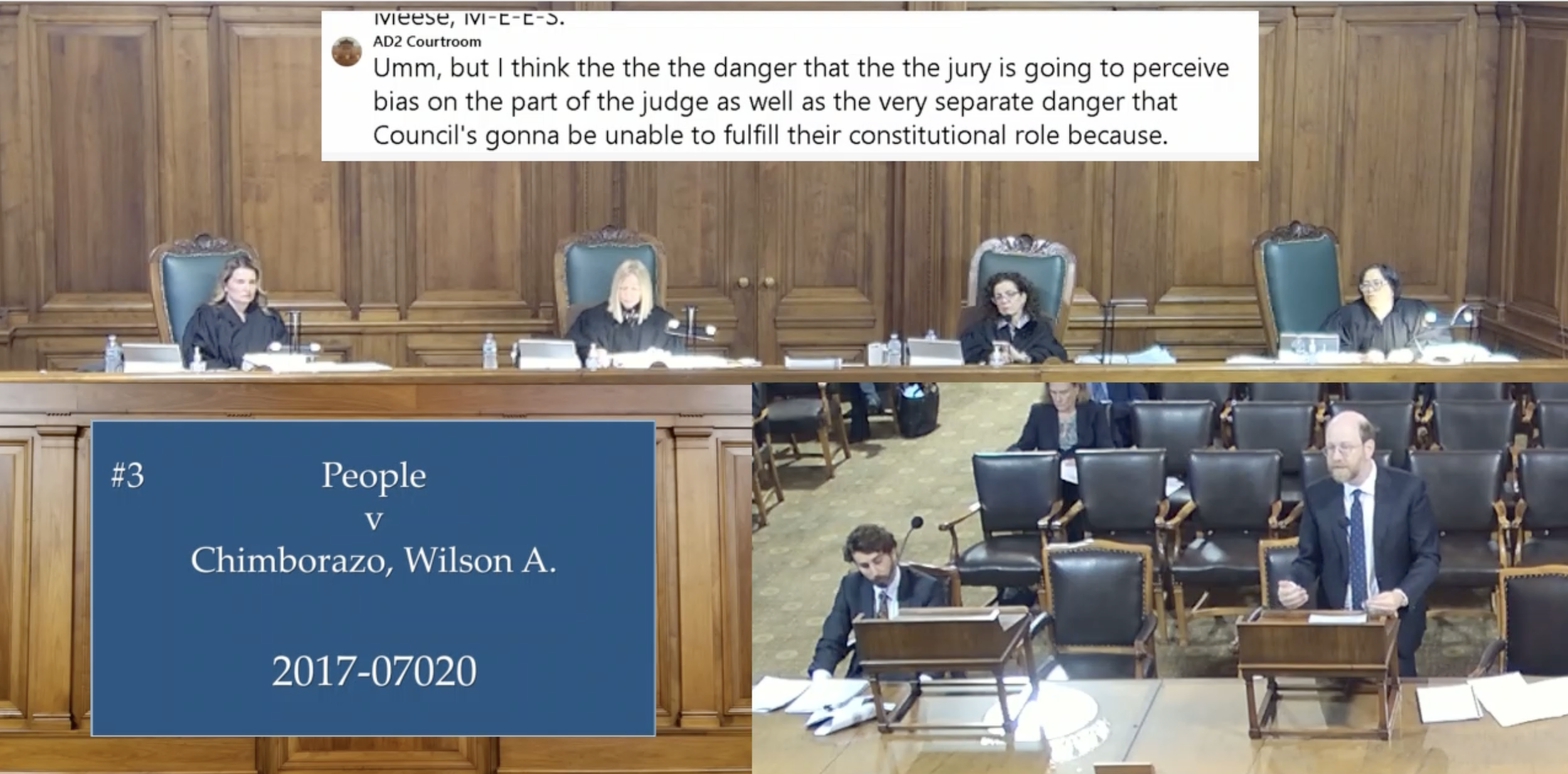
The Appellate Division, Second Department ordered a new trial in the case of Wilson Chimborazo after his attorney successfully argued that the original judge in his case improperly interfered with the burglary trial. Screenshot via Appellate Division, Second Department
By Jacob Kaye
A man’s 2017 burglary and assault conviction was tossed by a group of appeals judges last week after they ruled that the Queens judge overseeing the case appeared to act like a prosecutor instead of an independent arbiter.
Wilson Chimborazo will get a new trial nearly a decade after he was convicted of burglary, assault and bail jumping and sentenced to 17 years behind bars, judges in the Appellate Division, Second Department recently ruled.
The judges said Chimborazo’s right to a fair trial was violated by the judge overseeing his case, Ronald Hollie, who displayed a bias toward prosecutors as the relatively short trial played out in Queens Criminal Court.
Hollie, who retired from the bench in 2020 and died two years later, interjected a number of times when Chimborazo’s attorney was questioning witnesses and appeared to communicate to the jury that he favored the prosecution’s arguments.
“There must be a new trial, before a different Justice, because the Supreme Court conducted excessive and prejudicial questioning of trial witnesses,” the decision read.
While the appeals judges rejected Chimborazo’s claim that his convictions were not supported by legally sufficient evidence, they ordered a new trial in the case based on Hollie’s behavior alone. The judges also declined to rule on Chimborazo’s argument that his 17-year sentence was excessive because he’ll receive a new sentence if he is again convicted.
It’s not the first time the late judge’s conduct has been flagged for bias.
The Appellate Division, Second Department has made similar rulings on cases Hollie oversaw on at least eight different occasions.
Chimborazo’s attorney, Sam Feldman, a senior attorney with Appellate Advocates, told the panel of judges during a September court appearance that Hollie’s interjections during the trial were excessive.
“The court's extraordinary interference in this case with the presentation of evidence at trial denied Mr. Chimborazo his constitutional right to a fair trial,” Feldman said.
The former Queens judge asked 167 questions during the trial.
Feldman said Hollie’s questioning created two problems.
“It prevented defense counsel from pursuing coherent lines of questioning, from impeaching the prosecution's witnesses,” he said.
“But the other is the danger that the jury may have perceived that the court was leaning in a particular direction through constantly assisting the prosecutor in presenting this case,” he added. “Of course, it's fundamental to our system that the role of the trial judge is to be a neutral arbiter, and any risk that the jury perceives partiality on the court's part is something to be taken very seriously.”
At one point during Chimborazo’s 2017 trial, the defendant’s attorney was questioning a witness and attempting to argue that Chimborazo’s crimes were explained by the fact that he was intoxicated.
“When you say you smelled alcohol, the man was very intoxicated, wasn’t he?” the attorney asked the witness.
That’s when Hollie interrupted in a way Feldman claimed crossed the line.
“Well, would you know if he was intoxicated, or you just smelled alcohol?” the judge asked the witness.
Nicholas Isaacson, an attorney with Queens District Attorney Melinda Katz’s office, told the appeals judges during the September appearance that Hollie’s remarks were only made in an effort to clarify testimony to the jury.
“I would say in that case, the court was merely rephrasing a defendant's improper question,” Isaacson said.
But the appeals judges ultimately found that Hollie veered too far during the trial and behaved too much like a member of the prosecution.
“Here, the court interjected itself into the questioning of multiple witnesses and generally created the impression that it was an advocate for the People,” the ruling read.
The Queens District Attorney’s office did not respond to a request for comment.
The Appellate Division, Second Department in 2020 made a similar ruling on an attempted assault case Hollie oversaw.
As in Chimborazo’s case, Hollie asked a number of questions of witnesses and made it appear as though he was aligned with the DA in the 2016 trial of Wilfridy Martinez, who had been arrested a year earlier for stabbing a man outside a Jackson Heights bar, according to the Daily News.
The 2020 case marked at least the eighth time a conviction overseen by Hollie had been overturned for the same reason.
Hollie, a Queens native, began serving as a Civil Court judge in Queens in 1998. He was elected to the Supreme Court in 2000, where he served for two decades.
He died in 2022.